
Is It Sleep Paralysis or a Ghost? What 'Spooky in Love' Gets Right About Korean Gawi-Nulrim (가위눌림)
[Spooky in Love | Image credit: tvN / Netflix]
If you were watching the romantic comedy Spooky in Love with English subtitles, you might have paused during Ma Gang-uk’s bedroom scene in pure confusion.
The subtitle plainly reads: "sleep paralysis."
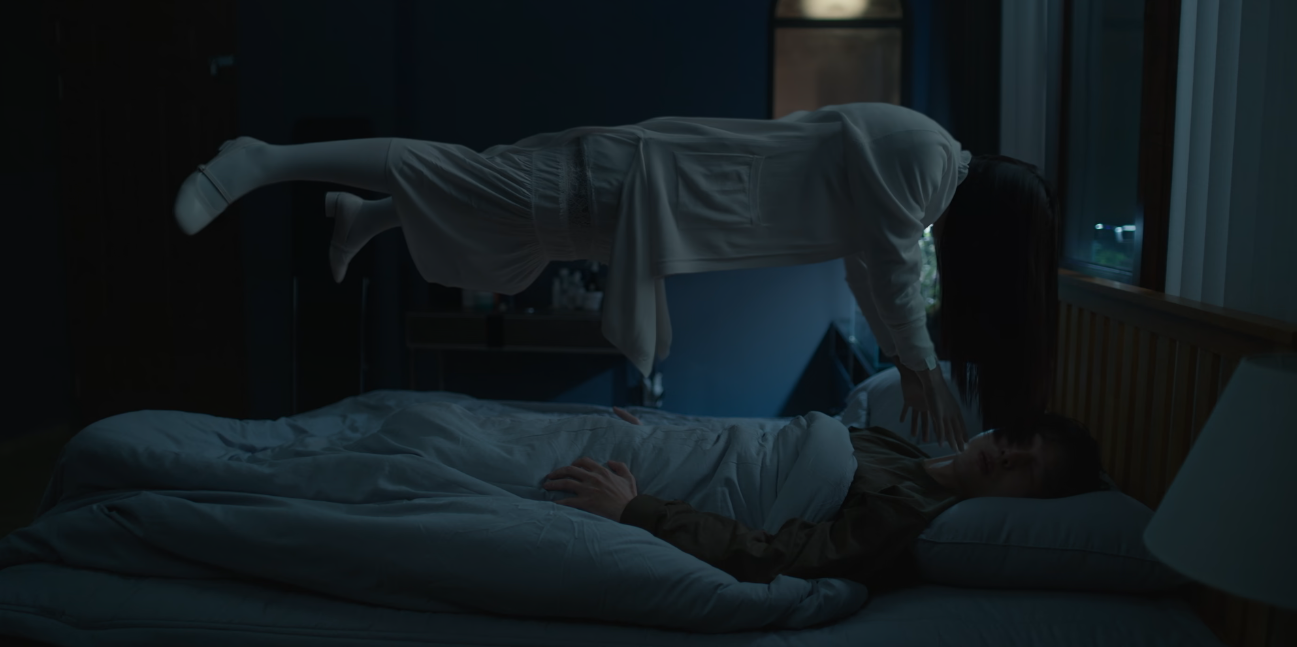
Yet what unfolds on screen is pure supernatural horror: a white-robed specter hovers horizontally in mid-air, palms extended downward, with thick curtains of black hair cascading toward Gang-uk's frozen face as he struggles to breathe.
To an international viewer accustomed to Western medical terminology, labeling this sequence as sleep paralysis feels clinical and contradictory. In the English-speaking world, sleep paralysis is understood as a neurological glitch—a temporary episode of muscle atonia where conscious awareness boots up before the body's chemical motor block wears off.
In Korea, however, this phenomenon is known as gawi-nulrim (가위눌림). Far from a sterile sleep disorder, it carries a visceral, terrifying cultural weight that textbook science fails to capture.
The Linguistic Trap: It’s Not About Scissors
Modern Korean speakers often chuckle when encountering the word because gawi (가위) is the everyday word for "scissors." However, this common assumption is a misleading mix-up.
gawi (가위): Traces back to old Middle Korean roots (such as gahoe), historically referring to an oppressive night phantom, bad spirit, or suffocating nightmare entity.
nulrim (눌림): Derived from the passive verb nulrida (눌리다), meaning "to be pressed down," "crushed," or "flattened beneath a heavy physical weight."
When a Korean says, "I was pressed by gawi last night" ("나 어젯밤에 가위눌렸어"), the mental image is not a malfunctioning nervous system. The phrase literally means being physically crushed down by an oppressive nighttime entity.
The Great Divide: Textbook Theory vs. The Lived Night
Within South Korea today, an intriguing divide separates those who observe from the sidelines and those who have lived through the horror.
People who have never experienced an episode comfortably explain the whole thing away using clinical textbooks. For skeptics, it is easy to dismiss the phenomenon as temporary REM sleep atonia triggered by irregular sleep habits, intense occupational stress, or simply lying flat in a supine position.
The moment someone experiences an actual episode, however, textbook logic instantly evaporates. The sheer, suffocating terror shatters all scientific detachment, replacing clinical theories with the chilling, undeniable conviction that an external, malicious force is actively invading the bedroom.
The fundamental flaw in modern clinical definitions is their sterile description of the physical sensation. Medical literature defines sleep paralysis as generalized, passive immobility accompanied by vague chest tightness.
Those who have lived through gawi-nulrim, however, report an experience that is dynamic, directional, and distinctly localized.
The Physics of the Haunt: The Climbing Weight
The physical sensation of gawi-nulrim does not fall across the entire body like a uniform blanket. Independent accounts consistently describe an external force that lands on the lower body—at the ankles, shins, or knees—and deliberately steps, treads, or crawls upward toward the chest.
The pressure feels remarkably focused, matching the concentrated surface area and weight of another human being pressing down with physical hands or feet. Step by step, the weight moves up the torso until it settles squarely on the sternum and throat to choke out the sleeper's air.
This shared, uniform experience explains why Korean cinema and television stage the phenomenon with such uncanny visual consistency:
In Spooky in Love: The director stages this exact localized downward force. The ghost hovers horizontally above Gang-uk with locked arms and outstretched palms, pressing downward into his chest.
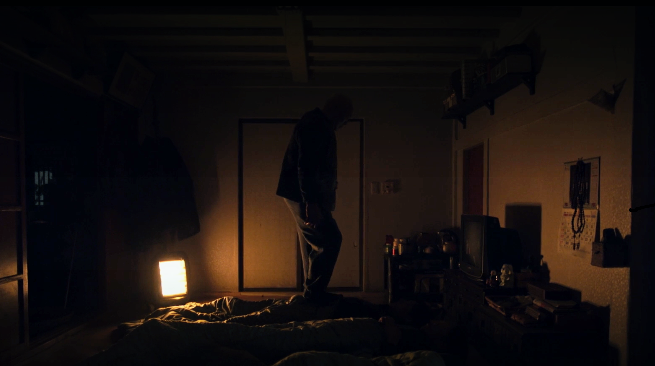
In the film Exhuma (Pamyo, 파묘, 2024): When Bong-gil (Lee Do-hyun) suffers gawi-nulrim, director Jang Jae-hyun does not portray it as abstract numbness. A dead Buddhist monk's spirit physically stands directly on top of Bong-gil's body, treading across his frame with heavy, rhythmic steps.
[Exhuma (Pamyo, 파묘) | Image credit: Showbox / Pinetown Production]
Furthermore, while the vocal cords and major limbs remain locked, survivors often find they can still twitch their toes, pry open their eyelids, or move their eyes. Those who manage to look upward consistently describe the exact same terrifying visual: a dense, pitch-black shadowy figure looming directly over them.
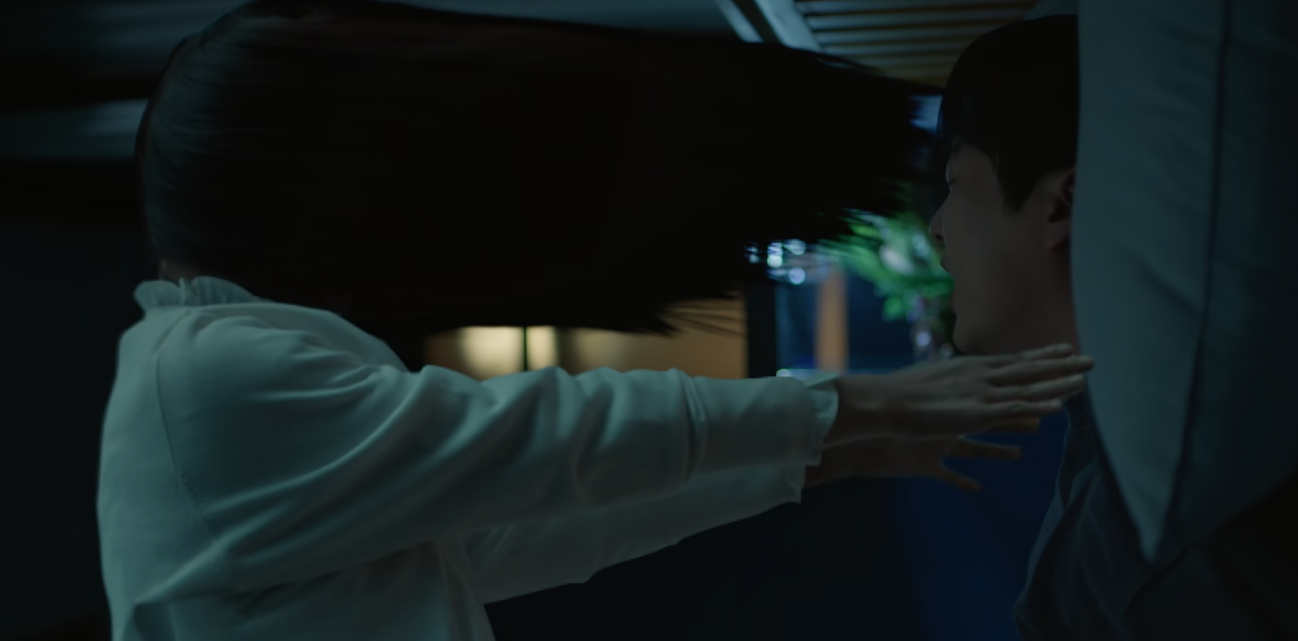
In Spooky in Love, the production translates this dark mass into a visceral physical form: the ghost’s long, black hair hangs straight down into Gang-uk’s face, creating the suffocating canopy of darkness reported by countless survivors.
[Exhuma (Pamyo, 파묘) | Image credit: Showbox / Pinetown Production]
If this were merely random neurological distress, why would millions of unconnected individuals across generations experience the exact same directional, climbing assault and see the exact same shadowy silhouette?
Editor’s Note: The Night I Decided to Open My Eyes
I am no stranger to gawi-nulrim, and I am a firm believer that it is far more than a simple medical symptom.
From my youth through my late thirties, I experienced gawi-nulrim frequently. During those years, I was in peak physical condition—working out regularly, carrying significant muscle, and receiving consistent clean bills of health from my doctors.
However, that period was also when I was deeply connected to my faith and heavily rooted in church life. Looking back, those recurring episodes felt like targeted spiritual warfare by an evil presence attempting to sever my spiritual connection.
Out of all those encounters, one specific night remains permanently burned into my memory.
Paralyzed on my bed, I decided to stop cowering and intentionally forced my eyes open to confront whatever was in the room. The moment my eyelids parted, an unseen hand descended rapidly to cover my eyes, blocking my direct line of sight.
Through the narrow gaps between the fingers, I caught a brief, split-second glimpse of a dense, pitch-black shadowy figure.
It was pure, unadulterated terror—a level of fear so profound I had never experienced anything like it in my entire life. The descending hand felt as though it was shielding me from being exposed to a horror so overwhelming it could have killed me on the spot.
What surprised me most was my own reaction: I literally screamed like a little girl.
Having served in the military during wartime, I had already proven my courage under extreme circumstances. Waking up from that episode, what haunted me most was not just the vision, but the humiliating fact that a hardened veteran had been reduced to shrieking in helpless dread.
Years later, during a church sermon, I recall a biblical account describing how a hand was placed over someone's eyes to shield mortal vision from being destroyed by an overwhelming presence, sparing his life. I had never encountered that account prior to that sermon, and hearing my experience echoed in scripture was chilling.
Decades have passed, and I no longer experience gawi-nulrim.
Today, my physical profile tells a completely different story. I have aged, lost much of the muscle mass I was once known for, and deal with pre-diabetes alongside high cholesterol. I carry the relentless, round-the-clock stress of providing for my family as the head of a household, with little time, money, or energy left to work out or decompress.
By every modern medical textbook metric, the clinical causes for sleep paralysis—chronic exhaustion, unmanaged stress, aging, metabolic strain—are far more prevalent in my life now than ever before. Yet the episodes have vanished entirely.
What changed? Under the heavy burdens of daily life, my faith journey evolved along a different path than the traditional church life I once knew, and I am no longer an active churchgoer.
If gawi-nulrim were merely an involuntary neurological misfire caused by fatigue and stress, it should be happening more frequently than ever. My own life proves that clinical science only explains the vehicle—not the passenger.
The Mind-Body Bridge: "몸이 허하면 헛것이 보인다"
Traditional Korean philosophy reconciles the medical trigger with the spiritual reality through an ancient, foundational saying:
"When the physical body is deficient and hollowed out, you begin to see phantoms."
"몸이 허하면 헛것이 보인다" (Momi heo-ha-myeon heot-geosi bo-in-da)
In Korean thought, physical exhaustion, chronic stress, and depleted vitality (heo-yak, 허약/虛弱) do not disprove the presence of a spirit; rather, they explain the physical vulnerability of the host.
When your internal defenses collapse, your protective energetic barrier thins out. That bodily depletion creates an open gateway, leaving the sleeper vulnerable to opportunistic wandering spirits looking to siphon vitality.
Hopefully now you understand why the scene described as sleep paralysis in Spooky in Love was showing a ghost with long black hair hovering over the main character, pressing him down into his bed.
Do you think it is merely a medical condition, or a true spiritual phenomenon? Have you ever experienced gawi-nulrim yourself? If you were pinned beneath that suffocating weight, did you force your eyes open, or would you dare to? And if you did... did you scream like a little girl?
Drop your wildest nighttime stories in the comments below! And if you want to know how traditional Korean culture keeps the body fortified against these nocturnal visitations, be sure to check out our article: The Secret Science of Yang Energy (Yang-gi) in Netflix’s The East Palace: Why Korean Ghosts Are So Hungry
