
The Ultimate Dalgona Deep-Dive: What Squid Game Didn't Tell You About Korea’s Iconic Sugar Brittle
[Squid Game Season 1 | Image credit: Netflix ]
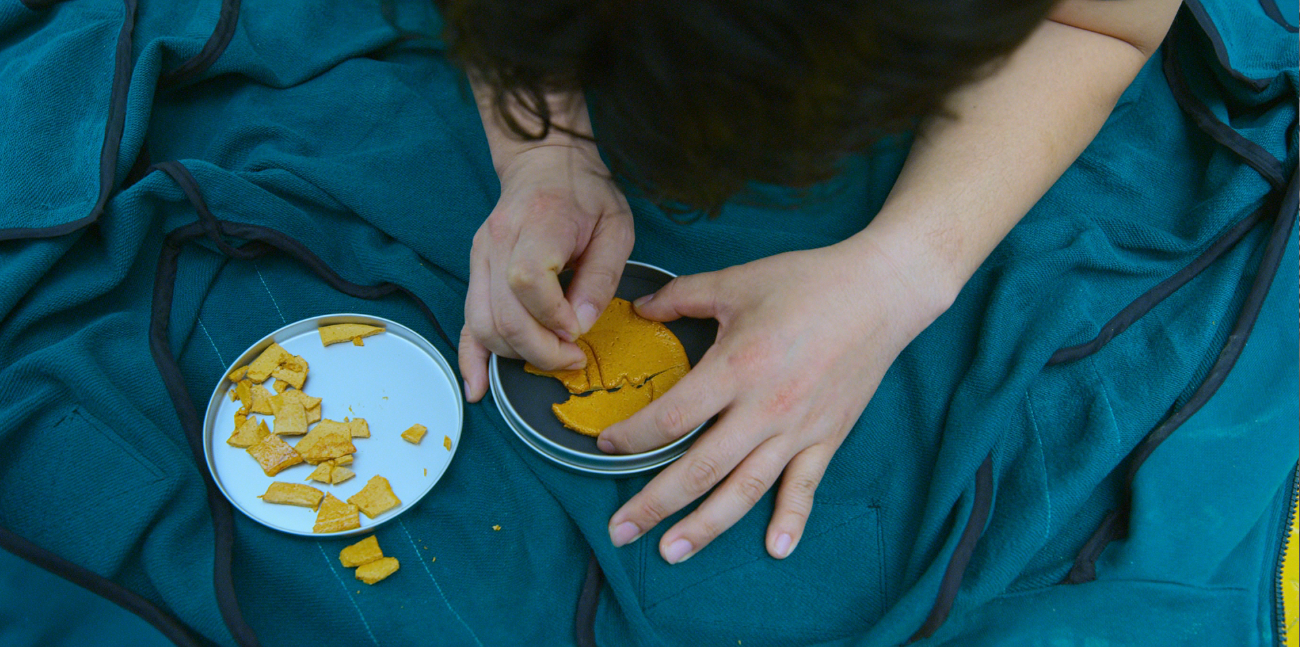
If you watched the iconic, white-knuckle second game in Season 1 of Netflix’s Squid Game, you know the sheer terror of watching grown adults sweat over a tiny needle and a delicate disc of honey-colored candy. To global audiences, it became known overnight as the Dalgona Challenge.
However, as a longtime K-Drama fanatic who has spent plenty of time on the ground in South Korea, I need to let you in on a little secret: Dalgona isn't actually the name of the game. It’s the name of the crispy sugar brittle itself!
Growing up with authentic Korean street food traditions, I am much more used to calling the game Ppopgi (뽑기). Let’s break down the hidden cultural nuances, the science behind the shapes, and how locals actually enjoy this nostalgic treat beyond the screen.
The Name Game: Dalgona vs. Ppopgi (and the Regional Map!)
While international fans group everything under the catch-all term "Dalgona," old-school locals know there is a distinct difference between true Dalgona and Ppopgi.
The Chemical Divide
Original Dalgona (달고나): Historically originating in the 1960s, true Dalgona was made by melting solid cubes of refined glucose over an open flame in a tin ladle, then stirring in a touch of baking soda. It had a slightly bitter, chemical sweetness and wasn't stamped with patterns.
Ppopgi (뽑기): Derived from the Korean verb ppopda (뽑다), meaning "to extract" or "to pluck," this is the version featured in Squid Game. It is made with pure white or brown granulated sugar. Because melted sugar hardens with a glassy structural matrix, it can be pressed flat and stamped with shapes for the iconic extraction game.
What Do Locals Call It? (The Regional Map)
Depending on where you grew up in South Korea, asking for this treat at a street cart required very different local slang:
Seoul / Gyeonggi:Ppopgi (뽑기) or Dalgona (달고나)
Chungcheong & Jeolla Provinces:Ttigi (띠기) — a regional dialect shift meaning "to detach" or "to peel off."
Daegu & Gyeongbuk:Gukja (국자) — literally named "Ladle," after the tool used to melt it over coal briquettes!
Busan & Gyeongnam:Jjokja (쪽자) or hilariously, Ttong-gwaja (똥과자), which translates to "Poop Cookie" due to its puffy, unpressed brown appearance if you mess up the baking soda ratio!
Shape Difficulty Tiers & The High-Stakes Street Prize
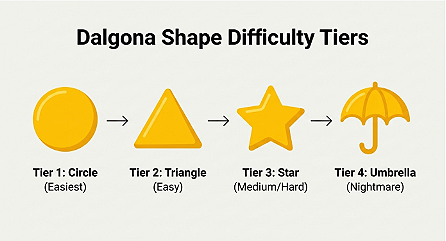
The shapes stamped into the candy aren't just random decorations—they represent a physics-based hierarchy of structural tension. When the hot, caramelized sugar cools, acute inner angles act as stress concentration points.
In real life, the stakes on the school streets were purely sweet reward! If you successfully extracted your shape without breaking it, the street vendor rewarded you with extra free Dalgona. The harder the shape you cleared, the more free candies you won! And if you snapped the shape and failed? You didn't face elimination like in Squid Game—you simply got a "Gwang" (꽝), the classic Korean game term for a complete bust, dud, or zero-prize result!
Tier 1: Circle (동그라미) — Very Easy: Zero corners and even stress distribution. You can snap the edges off with your fingers! Clearing it usually earned you 1 basic bonus candy.
Tier 2: Triangle (세모) — Easy: Wide 60-degree angles ensure the fragile points don't pinch too tightly. A clean extraction meant 1 extra treat for your efforts.
Tier 3: Star (별) — Medium/Hard: Five acute outer points and five deep inward indents. A single micro-fracture shoots straight through the center. Successfully carving this out paid off with a bigger 2-candy jackpot!
Tier 4: Umbrella (우산) — Extreme Nightmare Mode: Long, narrow handle pathways combined with delicate scalloped canopy curves mean the handle snaps 99% of the time! If you pulled off this absolute miracle, street vendors would shower you with 3 or more free candies—though most kids ended up with a total Gwang (꽝)!
✈️ The "Lost" Traditional Shapes
Before Netflix standardized the four game icons, 1980s street vendors had far more chaotic brass stamps, including:
The Airplane (비행기): A structural nightmare featuring delicate wingtips and tail fins.
The Swallow/Bird (제비): Intricate tail feathers that fractured under the gentlest breath.
The Heart (하트): A notorious trap thanks to the fragile top-center cleft.
Flavor Profile: What Does It Actually Taste Like?
If you’ve never tried fresh Ppopgi, the closest Western comparison is peanut brittle—minus the peanuts!
The high heat caramelizes the sucrose into a deep, rich, slightly burnt-sugar base, while the addition of sodium bicarbonate (baking soda) releases carbon dioxide gas. This creates millions of microscopic air pockets, giving the brittle a light, airy, honeycomb crunch with a surprisingly savory, slightly salty finish that cuts through the intense sweetness.
🍳 How to Make Dalgona at Home (Step-by-Step)
Want to attempt the challenge yourself? You only need two ingredients and a few metal tools!
Prerequisites:
2-3 tbsp granulated white sugar
A tiny pinch of baking soda
Stainless steel ladle, wooden chopstick, flat press plate, metal shape stamp, and a tray dusted with sugar.
Instructions:
Melt the Base: Hold the ladle directly over a low flame. Add sugar and stir continuously with a wooden chopstick as it liquefies into a clear, golden syrup.
Caramelize: Keep stirring off and on direct heat until all crystals dissolve into a smooth amber caramel.
Activate the Foam: Remove from heat completely. Add a microscopic pinch of baking soda and stir rapidly. The mixture will instantly puff up into a creamy, golden foam.
Pour & Rest: Pour the hot foam onto your pre-dusted tray. Let it sit for 4 to 5 seconds so a light outer skin forms.
Press & Stamp: Firmly press the metal plate down to flatten it into a disc, then quickly press your shape stamp halfway into the warm candy before it hardens!
The "Rebellion Method": How Native Koreans Eat It Unpressed!
There is another way native Koreans love to eat Dalgona that completely bypasses the shapes and press plates!
When making it at home or at certain old-school street stalls, you simply eat it while it is hot and freshly puffed without pressing it into a flat disc. You scoop the airy, hot foam straight out of the melting pan using a wooden chopstick, twirling it into a sweet, puffy marshmallow-like blob. It yields an incredible contrast: an ultra-crunchy outer shell with a soft, warm, soufflé-like honeycomb interior.
⚠️ CRITICAL WARNING: Liquid, aerated sugar holds extreme thermal energy! Eating it straight off the pan requires patience; if you don't let the outer crust cool for a few seconds, it will severely burn your mouth and tongue!
☕ The Modern Evolution: Dalgona Coffee (Korean Café Style)
In my opinion, the absolute best way to enjoy this sweet brittle today is paired with dark coffee. The rich, roasty bitterness of a deep black coffee or espresso shot brings a perfect balance to the caramel sweetness of the sugar brittle.
While the viral lockdown trend involved whipping instant coffee powder into a foam, authentic Korean cafes serve the real deal: Dalgona Latte (달고나 라떼), which features cold milk and dark espresso topped with heavy scoops of freshly crushed, crunchy Dalgona brittle bits (Dalgona Bunte). As you drink, the sugar slowly dissolves into the espresso, creating an evolving, toffee-flavored treat!
Major South Korean Chains Serving Dalgona Drinks:
If you're traveling in Korea, you can grab an authentic Dalgona drink at these major franchise chains:
Ediya Coffee (이디야커피): Famous for their staple Dalgona Latte, piled high with crunchy, caramelized candy bits.
Paik's Coffee (빽다방): Chef Baek Jong-won’s iconic budget chain serves an extra-sweet Dalgona Wonjo Coffee over crushed ice.
Mega MGC Coffee (메가MGC커피): Offers giant-sized iced lattes topped generously with crushed honeycomb crunch.
Final Thoughts
Whether you're testing your steady hand with a needle like Seong Gi-hun or sipping a crunchy Dalgona Latte at a bustling Seoul café, this humble street snack represents one of Korea's most enduring, delicious cultural exports.
Have you tried making Ppopgi at home yet? Did you manage to survive the Umbrella, or did you end up licking the back of dalgona? Let me know in the comments below!
