
The Conglomerate Engagement Flex: Why Spooky in Love Revived a "Dead" Korean Tradition
[Spooky in Love | Image credit: tvN / Netflix]
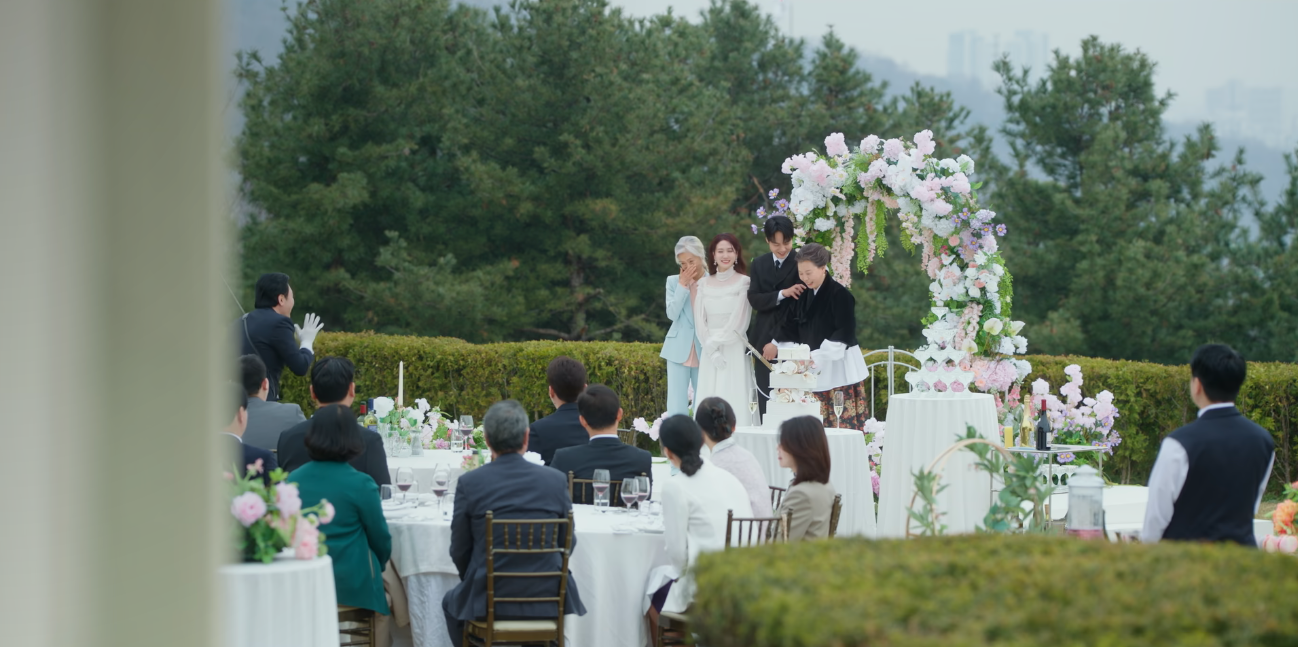
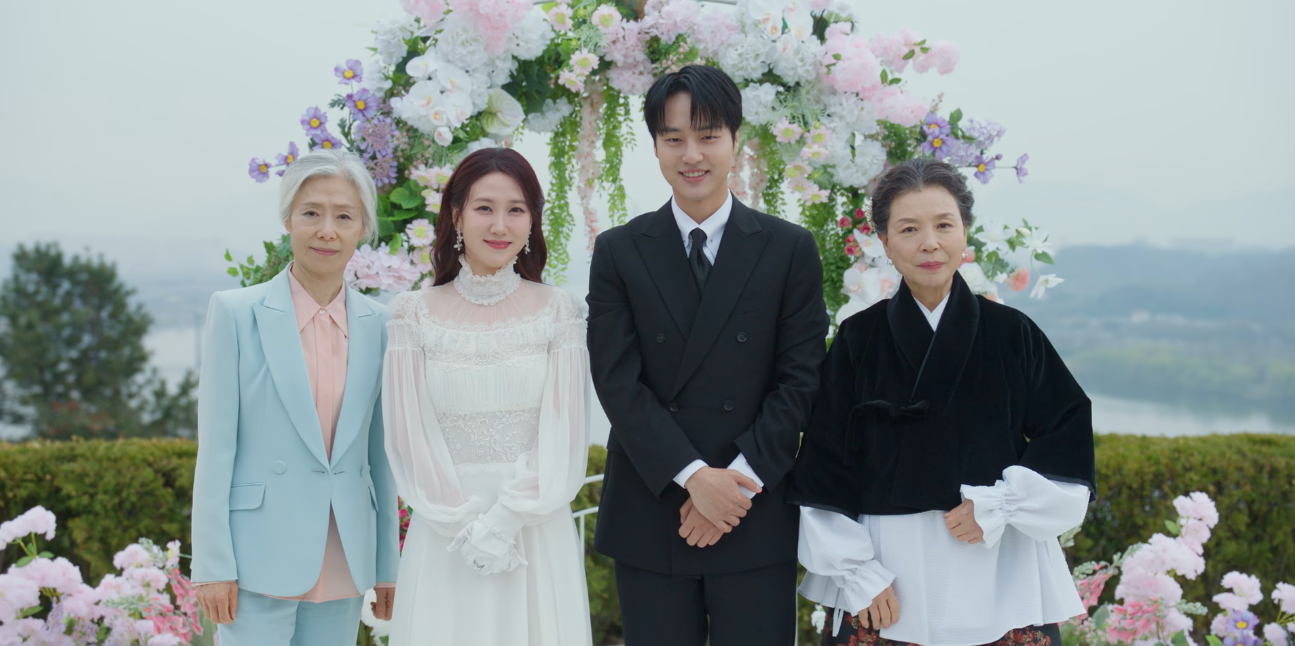
If you’ve been watching tvN’s romantic-comedy fantasy Spooky in Love on Netflix, you probably found yourself holding your breath during the lavish outdoor engagement ceremony. Set against manicured garden greenery beneath a pastel floral arch, the scene had all the makings of a fairy-tale celebration: a towering tiered cake, sparkling flutes of champagne, and the eager flash of press cameras. Yet, what truly stole the spotlight was the hilariously tense physical comedy of Ma Gang-uk carefully maneuvering a massive diamond ring onto Cheon Yeo-ri’s white-gloved hand—meticulously avoiding direct skin-to-skin contact.
To Western viewers accustomed to high-society television tropes, a picturesque garden engagement party looks entirely standard. But to a native South Korean audience, that grand outdoor event rang out like a lightning bolt for a completely different reason:
Real Koreans do not have engagement ceremonies anymore.
What looked like a charming romantic setup to international fans was actually a subtle storytelling code—a calculated visual flex signaling extreme wealth, institutional power, and rigid family hierarchy.
Here is the cultural TMI behind the extinct Korean engagement ceremony (Yakhonsik, 약혼식), why modern couples abandoned it, and how pre-wedding celebrations in Korea look entirely different from their Western counterparts.
What You Missed: The High-Society Engagement Ceremony Flex
For an international audience, an engagement party is often just an excuse to gather friends, pop champagne, and celebrate a recent proposal. But in modern South Korea, the ceremony itself is virtually obsolete for everyday citizens.
From the late 1970s through the 1980s, middle-class Korean couples occasionally held modest engagement ceremonies in rented neighborhood banquet halls. However, by the late 1990s, soaring commercial wedding venue costs, bridal package monopolies (Seu-deu-me / 스드메: Studio, Dress, Makeup), and the financial strain of paying for two separate, massive banquets led society to drop the ceremony completely.
Today, when an everyday Korean couple decides to marry, they seal the decision with a private proposal and move straight into wedding logistics.
So why did Cheon Yeo-ri’s family stage a full-blown engagement ceremony?
Because in modern K-dramas, the ceremony functions as narrative shorthand. When a script calls for a formal, public engagement banquet complete with press coverage and business dignitaries, the production design is signaling: This family belongs to the ultra-wealthy top 0.1% corporate elite.
By having Yeo-ri’s family orchestrate and fund this grand affair, the drama instantly establishes the household's immense capital, old-school lineage pride, and commanding social hierarchy. It is a visual demonstration that her family possesses the status to host an extravagant rite of passage that ordinary citizens abandoned decades ago.
Cocktails vs. Clan Alliances: The U.S. vs. Korean Engagement
To understand why the engagement ceremony carries such immense weight on screen, it helps to examine how Western and Korean traditions fundamentally diverged:
The Core Nature: An American engagement party is an informal, celebratory social mixer. In contrast, the Korean engagement ceremony was historically a formal, structured bilateral contract ritual.
The Primary Focus: In the U.S., the spotlight remains entirely on the couple's romantic announcement and peer celebration. In Korea, the ceremony was designed around the public alliance of two family lineages (Ga-mun / 가문).
The Venue and Atmosphere: Where Americans favor backyards, bars, or casual restaurants with informal toasting, the Korean ceremony required formal seating, designated event spaces, and an appointed master of ceremonies (Sahoija / 사회자).
Modern Frequency: While engagement parties remain a popular and flexible trend across the United States, the formal engagement ceremony has become extinct for the Korean general public, persisting almost entirely as a corporate dynasty plot device.
Pre-Wedding Parties: Why Yeo-ri and Gang-uk Skipped the Celebrations
Native Korean wedding customs never traditionally included bachelor parties or bridal showers. Historically, peer celebrations centered around lively, collective neighborhood rituals—most notably the groom’s close friends delivering the ceremonial wedding chest (Ham-jin-abi / 함진아비) directly to the bride’s family home on the eve of the nuptials. While separate bachelor parties were completely absent from traditional rites, the pre-wedding landscape has shifted among younger demographics, largely introduced and popularized by overseas study-abroad returnees (Yuhaksaeng / 유학생) and Western media exposure. Today, the Korean public generally considers modest, intimate celebrations acceptable, but flamboyant, excessive parties—especially wild nights hosted at nightlife clubs—are widely viewed as distasteful and inappropriate.
This social reality directly explains why Cheon Yeo-ri and Ma Gang-uk never throw pre-wedding parties or bridal showers in Spooky in Love. First and foremost, such gatherings simply do not belong to authentic Korean wedding customs. More importantly, indulging in lavish Western-style revelry carries significant reputational risk. In South Korea, high-profile figures in prestigious, elite positions—such as a rising public prosecutor like Gang-uk and the heir to a top-tier conglomerate like Yeo-ri—face intense public and family scrutiny. Staging raucous sendoffs would invite severe social backlash, clash with conservative expectations, and jeopardize the dignified public image both families are desperate to protect.
The Real Pre-Wedding Gatekeeper: The Sang-gyeon-rye (상견례)
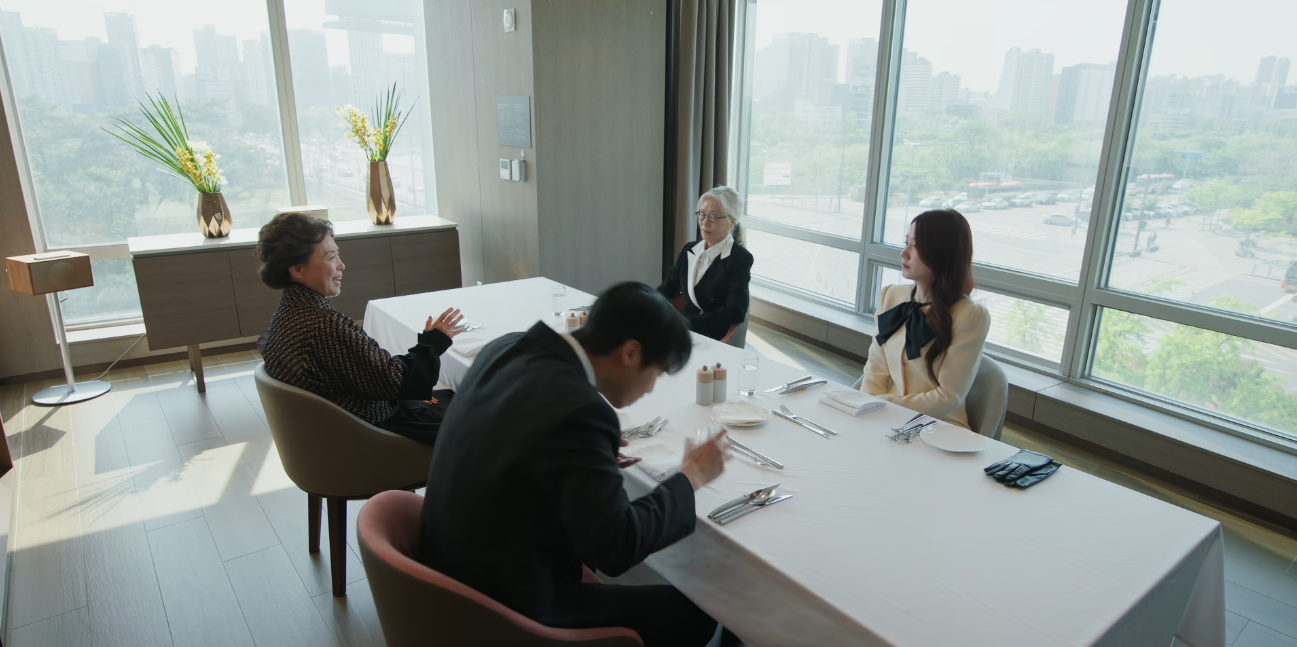
If ordinary Koreans no longer throw public engagement parties, how do real-life couples actually formalize their intent to marry? Enter the Sang-gyeon-rye (상견례)—the essential, non-negotiable family summit that every modern Korean couple must navigate. While an engagement ceremony was a grand, theatrical affair for extended networks, the Sang-gyeon-rye is an intimate, high-stakes gathering strictly reserved for the couple and their immediate parents. Held in a quiet, private dining room—typically an upscale traditional Korean course restaurant (Hanjeongsik / 한정식) or a discrete hotel dining suite—this dinner serves as the true cultural point of no return. During this meticulously paced meal, families formally evaluate each other's lineage, demeanor, and household pedigree through elevated honorific speech (Gyeok-sik-che / 격식체), negotiating wedding timing and expectations behind polite smiles.
[Spooky in Love | Image credit: tvN / Netflix]
We see this exact pressure-cooker dynamic unfold in Spooky in Love when Ma Gang-uk and Cheon Yeo-ri sit down for their formal Sang-gyeon-rye at the Reina Hotel. The meeting quickly transforms into a passive-aggressive duel between the two grandmothers: Gang-uk's grandmother, Madam Pang, and Yeo-ri’s grandmother, Chairwoman Baek. Madam Pang immediately brings up Saju (사주) and Gunghap (궁합)—the traditional cosmological readings based on birth dates and hours used by elders to forecast marital compatibility. Revealing that she had their compatibility checked, Madam Pang enthusiastically approves of the union because of Yeo-ri's supposed birth data: Gang-uk had previously lied to his grandmother, claiming Yeo-ri was born in the Year of the Horse. According to this fabricated fortune, Yeo-ri possessed the ideal cosmic alignment to provide devoted domestic support (Naejo / 내조) for an ambitious public prosecutor (Geomsa / 검사). Madam Pang uses this reading to set traditional ground rules, boasting about her grandson passing the bar exam before college graduation and expecting Yeo-ri to dedicate herself to his career.
In sharp contrast, Chairwoman Baek embodies the corporate matriarch who views such superstitions with detached practicality, dryly noting that she did not bother checking fortune readings because the couple had already made up their minds. When Madam Pang pushes for spousal deference, Chairwoman Baek politely counters with Yeo-ri's elite credentials—highlighting her admission to the world's top MBA program at Wharton and her future role running the entire Reina Group conglomerate. Chairwoman Baek clarifies that it is Gang-uk who will need to stand behind Yeo-ri as an external supporter (Waejo / 외조). This scene captures the fascinating generational reality in South Korea: while older relatives often treat Saju and Gunghap as serious family gatekeeping tools, contemporary Koreans view them primarily as casual, lighthearted compatibility quizzes—or, as Gang-uk and Yeo-ri experience, a minefield of parental expectations that must be navigated with absolute diplomatic care.
Ghosts, Dynasties, and In-Laws: The Ultimate Victory Lap
Watching Ma Gang-uk break into a nervous sweat while two formidable grandmothers turn a formal course meal into a chess match is peak romantic comedy. It strikes a chord because every viewer—Korean or international—instinctively recognizes the agony of an in-law ambush. Facing down a vengeful ghost or dodging a supernatural touch-curse is terrifying, but having your grandmother dissect a fabricated zodiac chart in front of a billionaire hotel chairwoman? That is a whole different level of psychological warfare.
When Gang-uk finally slides that sparkling ring onto Yeo-ri’s white lace glove beneath the garden floral arch, the scene hits on two distinct levels. On the surface, it is an opulent conglomerate flex reviving an engagement ritual everyday society abandoned decades ago. But underneath the pastel blooms and champagne flutes, it is the hard-earned victory lap of two souls who conquered supernatural hauntings, a buried past, corporate dynasty wars, cosmic superstitions, and the ultimate gauntlet: their own families.
[Spooky in Love | tvN / Netflix]
